57 Million Voted Early as Texas, Oklahoma, Louisiana Polls Open for Midterms
Voters in the South Central region face critical Senate and governor races amid record early turnout and competing party strategies.
By Ella Cox ·
More than 57 million Americans had already cast their ballots before Tuesday morning, a figure that surpasses the early vote totals from four years ago in many closely watched states according to the Associated Press. This surge in early participation sets the stage for a decisive midterm election halfway through President Donald Trump's second term. The results will determine which party controls Congress for the final two years of the administration. As polls open across the nation, the focus turns to the ground game and the specific turnout bets made by both parties.
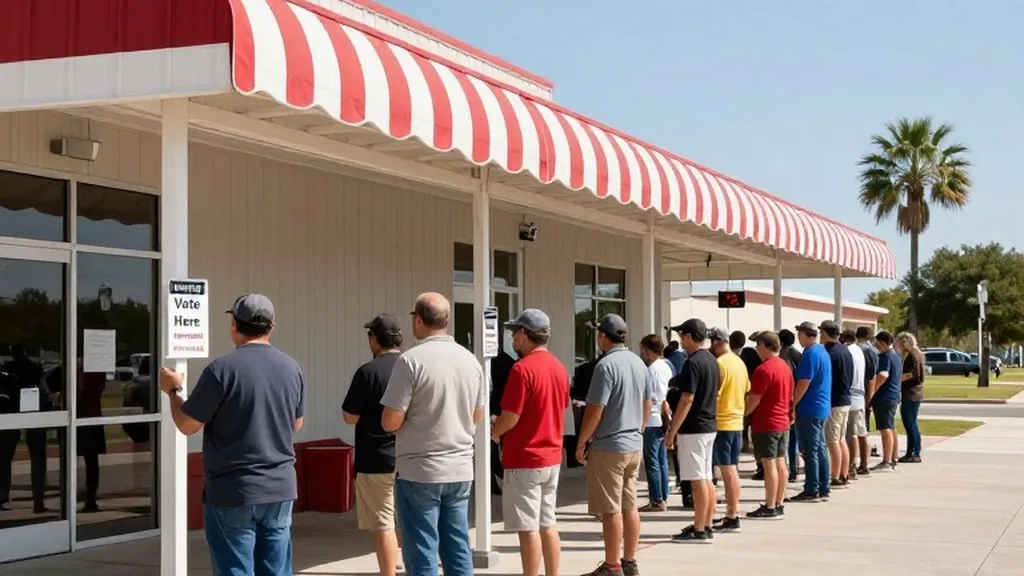
In Texas, polls are open from 7 a.m. to 7 p.m. local time, where voters will decide an open Senate seat and the fate of incumbent Governor Greg Abbott. The Associated Press notes that Texas is one of six states using new congressional maps following mid-decade redistricting. This change adds a layer of complexity to the race for the House, where Democrats need a net gain of three districts to secure a majority. Republicans, who hold 218 seats, can afford to lose no more than two. The state's new map may not vote as originally drawn, a concern shared by analysts watching the Southern region.
Oklahoma voters also began casting ballots at 7 a.m., with polls closing at 7 p.m. The state faces an open Senate race and an open governor's race, both critical for the national balance of power. Meanwhile, Louisiana polls opened at 6 a.m. and will remain open until 8 p.m. for Tuesday elections. Louisiana voters are deciding an open Senate seat, though no governor is on the ballot this year. Arkansas follows a slightly different schedule, with polls opening at 7:30 a.m. and closing at 7:30 p.m. In Arkansas, voters face incumbent Senator Tom Cotton and incumbent Governor Sarah Huckabee Sanders.
Party leaders have framed the election around turnout. RNC Chairman Joe Gruters stated that everything depends on getting their voters to the polls, asserting that if they turn out, they win. This reflects a strategy focused on mobilizing the base in states like Texas and the other South Central regions. In contrast, DCCC Chair Rep. Suzan DelBene emphasized that the American people are angry and want change. Her comments highlight the Democratic focus on the cost of living, health care, and oversight of the administration, issues that resonate strongly with voters in these states.
The Associated Press describes the election as a referendum on the current administration, with voters struggling with high prices and expressing anger over an unpopular war with Iran. Polling data from AP-NORC indicates that 35 percent of U.S. adults approve of the president's job performance, while about seven in ten believe the country is heading in the wrong direction. These sentiments are driving the ground game in states like Texas, where economic strain and tariff impacts are making the race more competitive. The Republican money edge, fueled by Trump-affiliated groups and Elon Musk, has been a significant obstacle for Democrats, who have nonetheless outraised their opponents at the candidate level.
In the Senate race in Texas, Republican Attorney General Ken Paxton is facing Democrat James Talarico. The Associated Press notes that President Trump backed Paxton over incumbent Senator John Cornyn in the primary. This matchup is part of a broader contest for the Senate, where Democrats need a net gain of four seats to take control. Republicans currently hold 53 seats and can lose only two. The race in Texas is seen as a bellwether for the South, where redistricting and new maps are playing a crucial role in determining the outcome.
The governor's race in Texas remains a key battleground as well, with incumbent Greg Abbott seeking re-election. The Associated Press has labeled the Texas governor's race as competitive, alongside Florida and Iowa. Democrats are hoping to hold a majority of governorships for the first time in two decades, a goal that requires winning specific races in states where Republicans currently hold the office. In the South Central region, the focus is on retaining the existing balance while pushing for gains in key districts.
Voters in these states are making their decisions amid a backdrop of administrative changes and legal challenges. A federal judge temporarily barred the Trump administration from carrying out a plan to prevent noncitizen voting, a move that critics say risks disenfranchising eligible voters. The U.S. Postal Service has added hours and staff to ensure mail ballots are counted on time, a critical step given the volume of early votes. These logistical efforts are essential in states like Louisiana, which has a mixed system of Tuesday and Saturday elections, and in Texas, where the new map may influence how votes are tallied.
The mood among Democratic voters is described as cautiously optimistic, with many citing the cost of living and health care as primary drivers. In Raleigh, North Carolina, a librarian named James Moore noted that he is paying more for taxes, healthcare, and everything else. This sentiment is mirrored in the South Central states, where voters are weighing the administration's performance against the backdrop of a potentially expensive election. The most expensive in history, the 2026 elections have seen Republican committees outraise and outspend Democratic committees, aided by significant financial support from Trump-aligned groups.
As polls close at 7 p.m. in Texas and Oklahoma, and at 8 p.m. in Louisiana, the day's voting will provide the first concrete data on the effectiveness of the ground game. The Associated Press reports that one or two seats could tip either chamber, making every vote count in these pivotal states. The new congressional maps in Texas and other states add a layer of uncertainty, as the lines may not align with traditional voting patterns. The election is not just about who wins, but about the future control of Congress and the ability to conduct investigations and oversight.