Breaking: Chip Stocks Plunge as Nvidia Loses $400 Billion in AI Rout
The Philadelphia Semiconductor Index posted its worst day since 2020 as Nvidia lost $400 billion and chip stocks plunged following Democratic wins on data center restrictions.
By Ella Cox ·
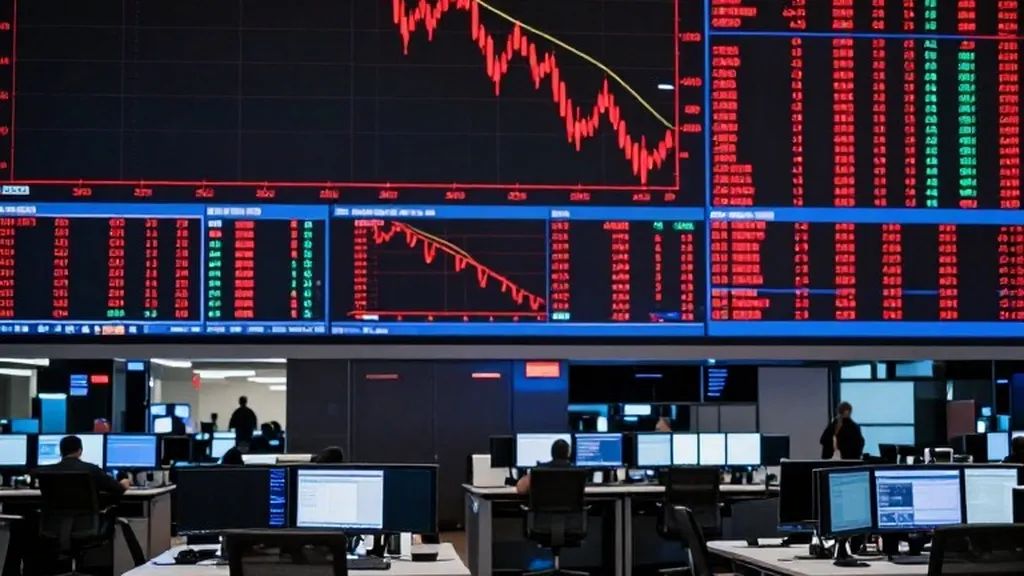
Chip stocks suffered a historic wipeout on Thursday as the Philadelphia Semiconductor Index posted its worst single-day performance since March 2020, plunging more than 12 percent. The rout was headlined by Nvidia, which shed more than $400 billion in market value after falling 9.2 percent to become the biggest decliner in the Dow Jones Industrial Average. The broader index of 30 large US companies dropped more than 1,800 points, a decline of 3.4 percent, to close at 51,868, erasing the gains made the previous day. This sharp reversal followed a rally on Wednesday when investors had anticipated that Democratic successes could restrain the White House, but the mood on Wall Street turned sharply negative as fears of an artificial intelligence bubble came to the forefront.
The damage extended deep into the semiconductor sector, with SanDisk falling more than 22 percent and Western Digital dropping 17 percent. AMD and Micron each fell more than 17 percent, while Intel declined 10.3 percent. The Philadelphia Semiconductor Index, which tracks 30 of the largest chip companies, has now fallen more than 30 percent since the beginning of October and stands almost 40 percent below its peak in June. The iShares Semiconductor ETF, known as SOXX, also fell 12 percent, marking its worst day since the breakout in March 2020.
The selling pressure was fueled by the aftermath of Tuesday's midterm elections, where Democrats secured a sweep of the House and Senate. Voters in various states rejected data center projects in a series of local ballots, a move that heightened concerns about the future of the infrastructure essential for AI development. In Texas, Democrat Gina Hinojosa won the governor's race after campaigning on an immediate moratorium on new data center construction. This victory, along with Democratic gains in Ohio, has led investors to question whether tighter state-level restrictions will slow the buildout of facilities that underpin the current AI trade.
Market volatility spiked dramatically as traders reacted to these political shifts. The Cboe Volatility Index, often called Wall Street's fear gauge, jumped as much as 5.7 points to above 28, its highest reading since March 31, 2026. By midday, nearly 800,000 VIX call options had traded, a volume that was 3.5 times the 30-day average. The Nasdaq Composite fell 5.5 percent, its worst day in 18 months, and closed more than 11 percent below the record it set last month, placing the index in correction territory. An estimated $2.5 trillion in market value was wiped from the Nasdaq Composite.
Analysts suggested that the market is grappling with the collision of political headwinds and financial skepticism regarding AI returns. Neil Wilson, investor strategist at Saxo UK, described the event as a complete capitulation-level event in tech stocks, noting that the fear of a total momentum unwind appears overdone but requires stability. Dan Ives, a tech analyst, stated that there is no way to sugarcoat the fact that Democrats taking control will create major hurdles for AI legislation. He added that the midterm results are a clear sign that the pace of data center build-out will start to slow, a sentiment echoed by Susannah Streeter, chief investment strategist at Wealth Club.
The tech industry itself is responding to the public backlash against data centers. Greg Brockman, president and co-founder of OpenAI, spoke at the WSJ Tech conference in Napa, California, on Wednesday evening, acknowledging that everyone had been surprised by the reaction to data centers. He emphasized the need to bring communities on board, stating that from San Francisco trying to build infrastructure in Texas and Georgia, you cannot just tweet and say this is going to be good, but rather you need to be in those communities. Dina Powell McCormick, president of Meta, told the same conference that the industry needs to double and triple down on telling the story of AI to the public.
Despite the severe drop, some strategists see potential for a recovery. Gene Goldman, chief investment officer at Cetera Financial Group, said the sell-off had become exaggerated as selling accelerated through the day, predicting a bounce back soon. He noted that corrections in a bull market are typically short-lived, even if the current situation appears ugly. Frank Cappelleri, founder of CappThesis, pointed out that the Nasdaq was higher 12 months after the election in all but one of 13 midterm cycles since 1974, though he cautioned that the path can be a volatile one. In 2018, the Nasdaq rallied the day after Democrats won the House, but a sharp December sell-off followed before the index recovered.
The broader market context showed mixed signals, with the 10-year Treasury yield falling to 4.83 percent, its lowest since September, as investors sought safety in bonds. The S&P 500 fell 4.3 percent, its worst day since April 2025, when President Trump announced sweeping global tariffs. The selling spread through every sector of the S&P 500 and gathered pace through the day. In London, the FTSE 100 closed down 46 points, or 0.4 percent, at 10,782.66, after an early rally in Europe fizzled, indicating that the global market was also feeling the weight of the US tech selloff.
Noel Smith, an options trader, said his data suggests de-risking, but his gut feels this is a blowout that could create a dip-buying opportunity. He observed that oil and interest rates were relatively unchanged and that the tape looks like a liquidation, which is exactly what it is according to what he is hearing with regards to a hedge fund. Ted Parkhill, founder and chief executive of Incline Investment Management, added that the market is moving from the promise of AI to the price of AI, suggesting that while AI will be transformative in the long run, not every AI-related stock is currently priced appropriately, leading to turmoil.
More Business · Consumer Alerts · Report a business · Got a Story?