US Sets Up Tampa Unit to Watch Iran Borders
Task Force Iron Gate will use drones and satellite data to track goods moving overland and through the Caspian Sea.
By Robert Ward ·
Washington has created a new military group to monitor what moves in and out of Iran. President Donald Trump announced the launch on Truth Social on Sunday, stating that very little now enters or exits the country. The unit, called Task Force Iron Gate, was officially formed the day before.
The task force is based in Tampa, Florida. It operates as an intelligence fusion cell rather than a large troop deployment. The group will coordinate with other agencies to watch for advanced weapons and sanctioned materials. It relies on satellite imagery, drones, and intercepted communications to track supply networks.
Trump said the unit is already fully active. He linked this effort to the existing US naval blockade of the Strait of Hormuz, claiming the two measures have nearly cut Iran off from global trade. Military analysts note that an intelligence unit cannot seal the entire border alone. They say the operation depends on sharing data and applying financial pressure instead of sending in soldiers.
Andreas Krieg, an associate professor at King’s College London, called the move a way to extend the naval blockade. He explained that the unit aims to make buying goods slower and riskier for Tehran. Krieg added that the operation does not intend to stop every shipment. He noted that the plan relies heavily on financial tools.
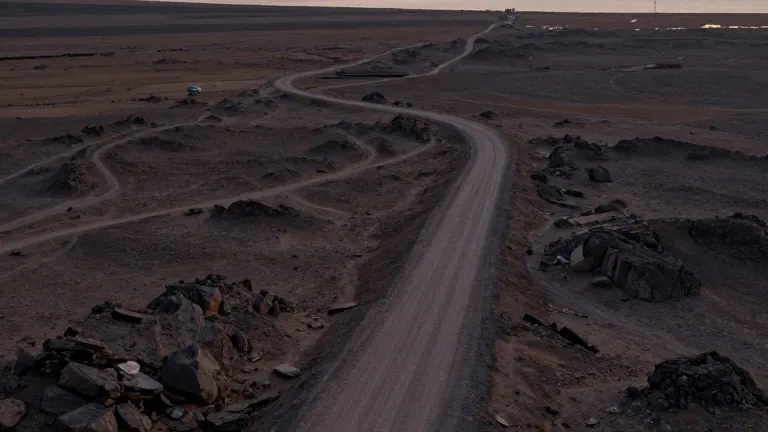
The unit may also watch routes between Iran and Russia. US media reports say Russia has sent drone parts and explosives to Iran via the Caspian Sea. Some reports claim Russian technology is helping Iran build supersonic cruise missiles. CENTCOM did not name Russia in its announcement, but analysts believe the task force targets these specific supply chains.
Political hurdles remain. Krieg said Iran’s neighbors are often unwilling to help fully. Iraq has some influence for Washington, but local networks are deeply embedded. Azerbaijan might cooperate quietly, while Turkmenistan wants to keep its neutral stance. Pakistan is mediating talks, so it is unlikely to join openly. Turkiye has little interest in another border conflict.
Rami Khouri, a fellow at the American University of Beirut, called the mission near impossible. He pointed out that Iran has long been a trading nation with deep ties to partners across Asia. These connections make it hard to block every entry point. Joe Kent, a former counterterrorism official, argued the unit aims to keep the war escalating while the White House negotiates. He said CENTCOM chief Brad Cooper and Defense Secretary Pete Hegseth are pushing Trump to renew attacks. Mahjoob Zweiri, a professor at Qatar University, suggested the move is largely symbolic. He noted the US lacks direct access to the Caspian Sea and needs cooperation from countries like Azerbaijan or Armenia. Because those nations are hesitant to upset Russia, Zweiri believes the task force will have limited impact without troops on the ground.