Trump's $5,000 Dividend Fizzles as Democrats Seize Congress in Wave
With Democrats now holding both chambers, the president's promise to pay every adult $5,000 if Republicans kept power is effectively void, raising questions about the campaign's final gambit.
By Ella Cox ·
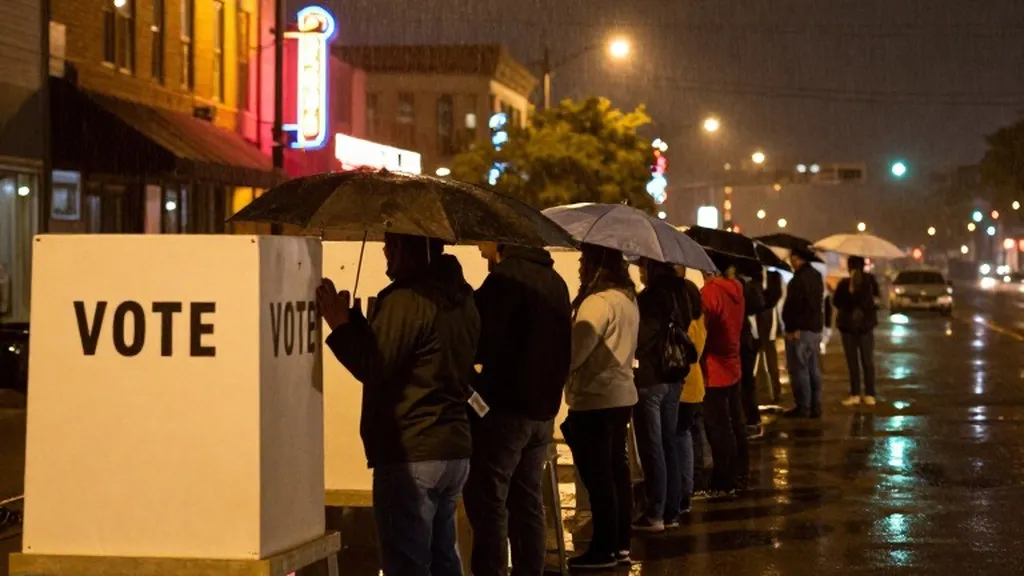
President Donald Trump's pledge to send $5,000 to every adult American citizen, a promise he made explicitly contingent on Republicans retaining control of Congress, has effectively become a nullity following Tuesday's midterm elections. Democrats captured majorities in both the U.S. House and Senate, ending the Republican hold on the legislative branch that the president had cited as the trigger for the payout. The result leaves the $1.2 trillion proposal, which Trump branded the Trump dividend, in a state of political limbo, with the president now facing a Congress controlled by the party he pledged to bypass in the payment process.
The promise was delivered during the Republican Midterm Convention in Dallas just days before the vote. Standing before a crowd of party loyalists, Trump declared that if the GOP won the House and Senate, 'you win with us and you get $5,000.' He framed the offer as a reward for the nation's economic performance, comparing the government to a successful company distributing cash to shareholders. The announcement was designed to energize the base, but it also introduced a new variable into the election: a direct financial incentive tied to a specific partisan outcome.
For voters in Texas and the broader South Central region, the dividend was a headline issue in the final stretch of the campaign. In Texas, where polls closed at 7 p.m., the race for the open Senate seat was particularly close. The state's governor, Greg Abbott, also sought reelection. The promise of a five-figure check from the federal government resonated with many working-class voters who have felt the squeeze of inflation, even as the war in Iran kept gas prices elevated. In Oklahoma, where polls also closed at 7 p.m., voters faced an open Senate seat and an open governor's race, with the dividend promise adding to the list of economic issues on the ballot.
Louisiana and Arkansas, also in the South Central region, saw high turnout. Louisiana's polls were open from 6 a.m. to 8 p.m. for Tuesday elections, while Arkansas operated on a slightly different schedule from 7:30 a.m. to 7:30 p.m. In Arkansas, incumbent Senate candidate Tom Cotton and incumbent governor Sarah Huckabee Sanders both sought to retain their seats. The Trump dividend served as a unifying theme for Republican candidates in these states, offering a tangible benefit that contrasted with the more abstract promises of their opponents.
Speaker Mike Johnson, who led the House Republicans during the campaign, insisted that the payment required congressional approval. 'I would assume, yes, he'd need Congress to act, and that's a creative idea,' Johnson said in an interview. He pledged to work to get the proposal through the chamber, noting that Congress would have to find consensus. However, with Democrats now holding a 250 to 157 majority in the House and a 54 to 44 majority in the Senate, the legislative path for the dividend has become significantly steeper. The new Democratic leadership is already signaling a focus on oversight and cost of living relief, which may not include a universal payout to all adults.
Bipartisan criticism of the plan emerged before the election. Texas Congressman Chip Roy, a Republican, questioned the wisdom of the payout, writing that 'Dependency is evil and soul-sucking in all its forms.' Even within the GOP, there were doubts about the fiscal impact. The payment would cost more than $1 trillion, a sum that would add to the nation's nearly $1.8 trillion annual budget deficit. Fiscal experts warned that such a large injection of cash could exacerbate inflation, a concern that was already top of mind for voters who reported feeling financial hardship from rising prices.
PolitiFact found that the biggest payment is far from certain, noting that the administration had announced no formal plan for the checks. The fact-checkers pointed out that while Trump cited tariff revenues as a potential funding source, the One Big Beautiful Bill Act passed in 2025 did not include a separate tariff dividend. The payment would first require Congress to approve the spending, a hurdle that Democrats now control. Senator Bernie Moreno, R-Ohio, had said he would introduce legislation to fund the proposal, but analysts noted that such a bill would likely need a 60-vote supermajority in the Senate, a threshold that is difficult to reach in a polarized chamber.
The election results suggest that voters were skeptical of the promise or that other issues outweighed the financial incentive. Democrats won at least 43 House seats and seven Senate seats, a swing that placed the election in the top 20% of midterm years in terms of seat shifts against the president's party. The loss was particularly sharp in states where the Republican party had held strong majorities for decades. The outcome indicates that voters were willing to change the party in control of Congress, effectively voiding the condition for the dividend before the money could be allocated.
In the immediate aftermath, Trump has maintained that the checks are still coming, telling reporters that 'The 5,000's going to happen, 100%.' However, this assertion contradicts the terms he set in Dallas. If the promise was conditional on Republican control, the shift in power to Democrats complicates the legal and political basis for the payment. The White House has not provided a detailed timeline or mechanism for how the checks will be distributed, leaving the promise as a talking point rather than a policy in motion.
The dividend promise also highlights the broader strategy of the Trump administration to use direct payments as a tool of political messaging. Similar to the $1,776 checks given to military service members and the proposed $2,000 tariff dividends that never materialized, the $5,000 check was designed to create a sense of shared prosperity. However, the failed promise may leave a lingering question among voters about the reliability of such pledges. As Democrats move to take office in January, they will face the task of addressing the cost of living without the immediate distraction of a massive, one-time federal payout.