El Niño storms: Record rain and rising rivers strain Southwest infrastructure
Hundreds of evacuations and two deaths occurred as historic rainfall swelled the San Juan and Animas rivers just before Election Day.
By Robert Ward ·
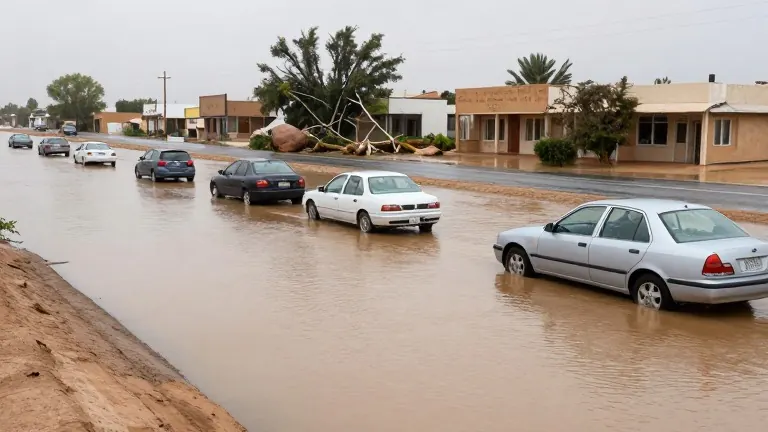
Unusually heavy rainfall turned arid creek beds into rushing torrents across the Southwest on Monday, forcing hundreds of residents to evacuate their homes. The National Weather Service linked the weather pattern to El Niño, a phenomenon driven by warming Pacific waters that disrupts typical seasonal forecasts. Swift-water rescue teams worked through the weekend and into Monday to pull people from rising water and trapped vehicles.
Ryan Maue, a former chief scientist at the National Oceanic and Atmospheric Administration, calculated that more than 20 trillion gallons of water fell on the Four Corners states and Nevada over the previous two weeks. The NWS estimated that up to four inches of rain could land in the region through Monday. This volume of water pushed the San Juan River in Colorado to 16.81 feet late Sunday night, a level that flooded downtown streets in Pagosa Springs before the water receded on Monday.
In Pagosa Springs, a town of roughly 2,000 residents, officials reimposed an evacuation order on Saturday after lifting one from a previous flooding event just the week before. Katie German, owner and chef at Bruin Coffee, reported that downtown streets flooded on Sunday. She expressed concern for her business, her employees, and the broader community. The Colorado Secretary of State's office arranged alternative voting plans for evacuated or marooned residents, allowing mail ballots to be returned at any drop box or vote center in the state by 7 p.m. on Election Day.
Police in Durango, Colorado, reported that the Animas River rose sharply, stranding people in their homes. Chief Brice Current said authorities were checking on residents who chose to ride out the storm. The river was closed to recreational watercraft, and officials warned that sewage and chemicals in the water posed health risks. Riverside trails and foot bridges were also shut down to prevent access to the flood zone.
Evacuation orders extended to communities along the San Juan River in New Mexico and across parts of the Navajo Nation. The village of Chama in New Mexico was evacuated and cut off by road closures. In Arizona, record rainfall was documented in multiple locations. Workman Creek, a wilderness area near Phoenix, received 7.3 inches of rain over two days. Flagstaff recorded 5.15 inches over the same period, marking the city's wettest November 1 in its history.
Two deaths were linked to the weather. Williams Singavarapu, 73, of New York, was found dead in a drainage tunnel in Flagstaff on Monday, about 15 blocks from where he fell into the floodwaters. A second unidentified man was found dead in a drainage area, with police stating the death appeared weather-related pending a formal investigation. In Sedona, officials ordered residents near Oak Creek to leave as floodwaters trapped multiple people in their homes. The heavy rain washed out a section of the main highway between Flagstaff and Sedona, leaving boulders and trees on the road and damaging guardrails.
Ryan Benally, a professor at Utah State University, spent the weekend building dirt berms to protect his parents' home on the Navajo Nation near Montezuma Creek, Utah. His parents, both in their 60s, had never seen flooding of this severity in the area. Benally coordinated the delivery of bottled water, boots, and toiletries to shelters while noting that emergency routes for remote residents had washed out. He described the storms as compounding in ways that left local communities unprepared.
In Tucson, meteorologist Aaron Hardin noted that the region received two or three months of expected rain in a matter of days. Residents in the Pinetop-Lakeside area reported sewage backing up into homes as manhole covers popped up under the pressure of the floodwater. The region's sanitary district announced these conditions as the water systems struggled to handle the volume.