Voyager 1 hits 16 billion miles as Earth's light now needs a full day to arrive
NASA confirmed the probe reached one light-day from Earth early Wednesday, marking 49 years of continuous operation since its 1977 launch.
By Ibrahim Howard ·
NASA confirmed Wednesday that Voyager 1 has reached a distance of 16.094 billion miles from Earth. At that range, a particle of light traveling at roughly 186,000 miles per second takes a full 24 hours to bridge the gap. The probe crossed this threshold around 4:16 a.m. CST on Wednesday.
Launched on September 5, 1977, Voyager 1 was designed to fly by Jupiter and Saturn. It surpassed its twin, Voyager 2, which had launched two weeks earlier, because its trajectory allowed it to reach the gas giants first. The mission has continued far beyond its original scope, becoming the most distant human-made object in space.
The spacecraft achieved its initial goals in the early 1980s. In 1979, it discovered active volcanoes on Jupiter's moon Io and identified two previously unknown moons, Thebe and Metis. It also captured detailed images of Jupiter's Great Red Spot. A year and a half later, it flew past Saturn, discovering three of its moons and identifying an Earth-like atmosphere on Titan.
After completing its planetary flybys, NASA extended the mission. Voyager 1 took its final photographic images at 3.7 billion miles from the sun. These included a Solar System family portrait showing planets as specks and the iconic 'Pale Blue Dot' image of Earth. That photograph inspired the title of astronomer Carl Sagan's book, 'Pale Blue Dot: A Vision of the Human Future in Space.'
The cameras turned off shortly after to conserve power for data collection. In 1998, the probe surpassed Pioneer 10 to become the farthest object built by humans. In 2012, it crossed the heliopause, the outer boundary of the solar wind, becoming the first Earth-made object to enter interstellar space.
The probe carries a Golden Record, a compilation of 115 images, nature sounds, music, and greetings in 55 languages. Sagan led the commission that curated the record, which includes messages from President Jimmy Carter and U.N. Secretary General Kurt Waldheim. An inscription on the surface reads, 'To the makers of music, all worlds, all times.'
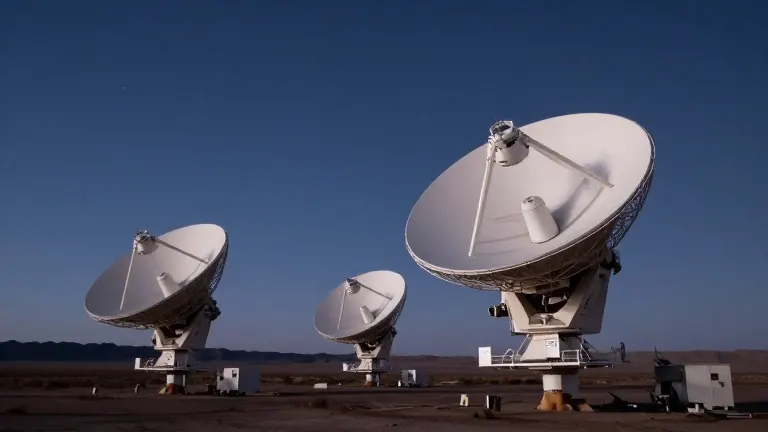
NASA has marked the light-day milestone by inviting people on Earth to shine lights. The signal will not reach the spacecraft until the following day. The agency maintains the Deep Space Network of ground stations to communicate with the probe. Voyager 1 is expected to remain within range of this network until about 2036, provided it retains enough power to transmit signals.
Recent years have seen technical challenges. NASA lost communications with the probe last month. In September, engineers powered down three devices and replaced them with lower-power alternatives, a process they called the 'Big Bang.' This move allows the spacecraft to continue operating longer without shutting down other instruments.
If science data collection ceases, NASA plans to continue analyzing engineering data. The probe continues to send information from the recesses of interstellar space despite its age and distance. It remains the primary source of data for researchers studying the boundary between the solar system and the galaxy.