NASA telescope expected to reenter atmosphere Friday
The Swift Observatory will begin burning up after a failed robotic rescue mission left it in a decaying orbit.
By Ibrahim Howard ·
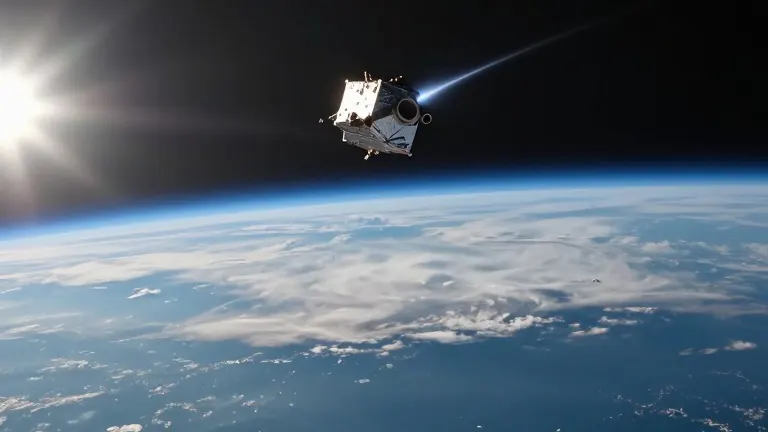
The Swift Observatory is falling from orbit. The U.S. Space Force predicts the 1.5-ton telescope will plunge back to Earth on or around Friday, November 6.
Most of the spacecraft will burn up in the atmosphere. However, NASA chief scientist Brad Cenko stated that denser components, including tungsten parts and mirrors, may survive the reentry. The Space Force is tracking a path that places landmasses in Africa, Australia, India, Southeast Asia, and the Americas within the potential impact zone, though ocean impact is more likely.
Swift launched on November 20, 2004, to detect gamma-ray bursts and supernovas. For two decades, it served as a first responder for other telescopes like Hubble and Webb. It identified more than 2,000 gamma-ray bursts and 1,400 exploding stars. Its ability to swivel quickly toward these events earned it its name.
The mission ended because its orbit decayed faster than planned. Intense solar activity in recent years pushed the telescope lower. NASA hired Katalyst Space a year ago to attempt a rescue. The company sent a three-armed robot named Link in July. Link failed to reach the telescope, staying 12 to 15 kilometers away before falling back to Earth in September.
Swift resumed observations after the rescue was cancelled. It continued detecting high-energy events until late October. By then, the telescope was too low in its orbit to maintain stability. Engineers shut down its systems.
John Nousek, an astronomer at Pennsylvania State University who led the control team, said the end was expected. He noted that objects in low-Earth orbit must eventually return to the planet. The team is mourning the loss while remaining grateful for the data collected over 22 years.
Nousek expressed hope in an email that lessons from Swift will apply to future space missions. Scientists are currently determining how to fill the observational gap left by the telescope's retirement.
Source: WXXV 25