The Science of Kindness: New research reveals how small acts spread through social networks
A study finds that receiving a kind act makes people 25% more likely to help others, challenging the idea that generosity is purely innate.
By Robert Ward ·
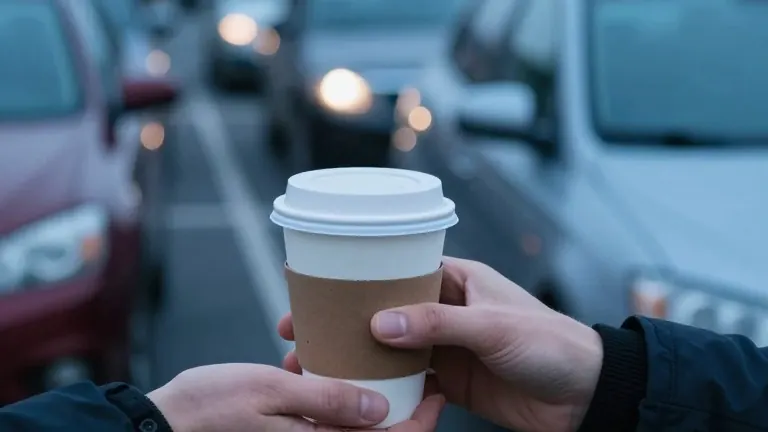
On a cold December morning in 2012, a stranger at a Tim Hortons drive-through in Winnipeg, Canada, paid for the coffee of the customer behind them. That customer did the same for the person next in line. The chain reaction continued until 226 customers had passed the gesture along. This specific incident became a data point in a larger investigation into how generosity moves through human communities.
Dr. Junaid Nabi, a physician-scientist at the RAND School in Washington, D.C., and a senior fellow at the Aspen Institute, compares kindness to a stone dropped in water. He argues that an act of kindness creates expanding ripples rather than acting as a single, isolated event. According to research cited by Nabi, individuals who receive a kind act become 25% more likely to help others. The study authors concluded that generosity toward strangers may be socially contagious, driven by the experience of receiving or observing help.
The motivation behind such acts often stems from empathy. Marta Serra-Garcia, a professor of economics and strategy at the Rady School of Management in the University of California, San Diego, studies the psychology of altruism. Her team published a study in the September issue of the Journal of Economic Behavior & Organization. The research revealed a paradox: people often prefer to give nothing rather than donate an amount they consider too small. This behavior occurs even when recipients would welcome any amount.
"It seems like an odd thing," Serra-Garcia said. "You're generous, but because you want to do the right thing, you might end up not giving at all, out of concern that your gift would be viewed as inappropriate or might even offend the other person." The study found that givers frequently overestimate the minimum amount recipients would find acceptable. This perception leads generous individuals to withhold help entirely to avoid the social discomfort of a perceived inadequate gift.
Maymunah Yusuf Kadiri, a neuro-psychiatrist and mental health advocate in Nigeria, witnessed the human impact of these small exchanges early in her career. In 2004, while working in the emergency room at Lagos State University Teaching hospital, Kadiri was exhausted and had not eaten for over 12 hours. An elderly cleaner approached her with a nylon bag containing a biscuit and a sachet of water. "Doctor," the cleaner said, "you need small strength to save people." Kadiri recalls that the act reminded her that healing involves human connection, not just medicine.
Kindness can also alter the trajectory of a life. Huguette Diakabana dropped out of school at age 10 in Zaire, now the Democratic Republic of Congo, because her family could not afford the fees while planning to emigrate to the United States. She sat outside her would-be classroom in an old uniform until the school director invited her inside. A mysterious donor had paid her fees. Years later, Diakabana discovered the donor was a school guard. He told her to help others when she could. Diakabana, who now lives in Switzerland, co-founded The Luminous Agency, a digital literacy nonprofit, and launched a scholarship program in his honor.
The origin of kindness remains a subject of study. Jeff R. Temple, a professor and psychologist at UTHealth Houston, says kindness is a central thread in his research on healthy relationships among adolescents. His team teaches students perspective-taking and the expression of care during disagreement. Temple notes that children who practice these behaviors are less likely to bully others because they understand the mechanics of healthy relationships.
The experience of giving can also transform the giver. In 2013, more than 1,000 garment workers died in the Savar building collapse in Bangladesh. Nabi arrived at the site as a Red Cross volunteer expecting to gain trauma care experience. Instead, he performed CPR on workers he knew would not survive and held the hands of those who did. He described the experience as shattering his previous mechanistic approach to clinical work. He now urges doctors to volunteer for humanitarian causes to practice compassion.
Nabi reflects that kindness is about showing up completely for another person's suffering. He notes that the image of workers embracing each other as the concrete fell changed his perspective permanently. Kadiri adds that when someone receives kindness, they become better. This shift in behavior continues the cycle, making the world a kinder place through repeated, measurable interactions.