European Airlines Face Coordinated Bomb Threats Triggering Military Escorts
Over a dozen flights across Europe were diverted or escorted by fighter jets following email threats attributed to an anti-feminist group, with no hazardous materials found on board.
By Ella Cox ·
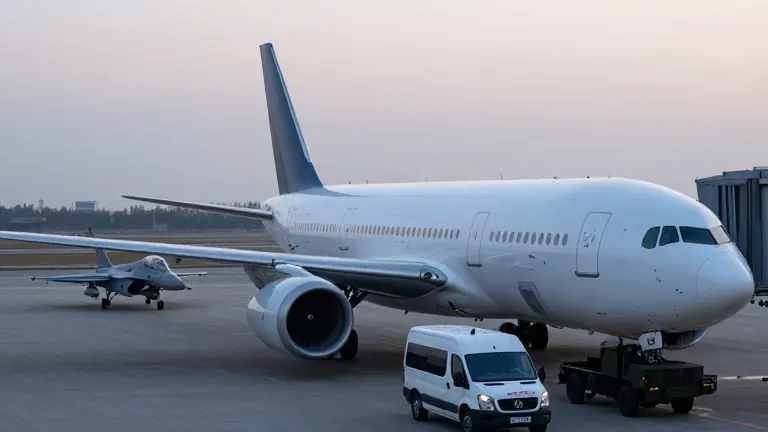
British Transport Secretary Heidi Alexander described recent disruptions to European air traffic as malicious hoax threats. More than a dozen flights faced bomb threats on Thursday, prompting emergency landings and military escorts. Authorities found no suspicious materials on the aircraft.
Emails sent to airlines included a message from a group identifying as anti-feminist. An airport official in Rome and another in a different European city reviewed copies of these messages. Both officials noted similar language in the threats but could not confirm if a single entity sent them. They spoke on condition of anonymity because they were not authorized to release the information.
An Aer Lingus flight from Dublin to Rome landed at a military base in Evreux, France. French Prime Minister Sébastien Lecornu ordered warplanes to intercept the jet because the pilot did not cooperate with authorities as expected. Military bomb disposal teams examined the plane, which remained on the tarmac with Red Cross vehicles nearby. French aviation security officials opened an investigation and questioned the pilot and co-pilot.
Italian air force fighter jets escorted a Finnair flight from Helsinki to Rome. Finnair stated that two of its flights faced unfounded hoax scares. The Rome-bound flight landed safely, while a second flight from Helsinki to Vienna landed safely and is expected to return to service after inspection. Three Ryanair flights bound for Sofia, Bulgaria, also received military escorts. Two landed in Sofia, and one from London diverted to Plovdiv, where CEO Krassimir Peshev confirmed the safe arrival.
Philip Baum, a visiting professor of aviation security at Coventry University, estimated each disruption could cost airlines up to $250,000. These costs cover crew overtime, replacement crews, and missed connections. He noted that such incidents disrupt airline schedules for the rest of the day. Governments bear the expense of military escorts. Jacob Funk Kirkegaard of the Bruegel think tank said the threats appear designed to sow chaos and test how European governments coordinate responses.
European Union Transport Commissioner Apostolos Tzitzikostas said it is too early to determine if the incidents are linked. He confirmed that national investigations are ongoing and that an EU information-sharing mechanism for aviation security has been activated. Similar threats affected flights earlier this week, including those operated by LOT, Scandinavian Airlines, Wizz Air, and Ryanair. A plane headed for Bulgaria diverted to Hungary after receiving a similar threat while airborne.
Czech police searched four planes in Prague after bomb threats, finding nothing. A LOT Polish Airlines flight from Warsaw to Brussels underwent inspections that revealed no hazardous items. A Wizz Air flight from Milan to Bucharest landed safely after checks found no bomb. Stefan Loidl, a police spokesperson in Lower Austria, said a flight to Warsaw landed in Vienna after an abstract threat. He also noted an abstract threat to Vienna Airport concerning four other flights, which did not disrupt operations. Air Serbia confirmed a hoax threat to a Belgrade to Bucharest flight, which resumed regular operations after checks.