Pope Leo visits Córdoba
An estimated 650,000 attendees heard Leo speak on holiness while he met families of the disappeared.
By Ibrahim Howard ·
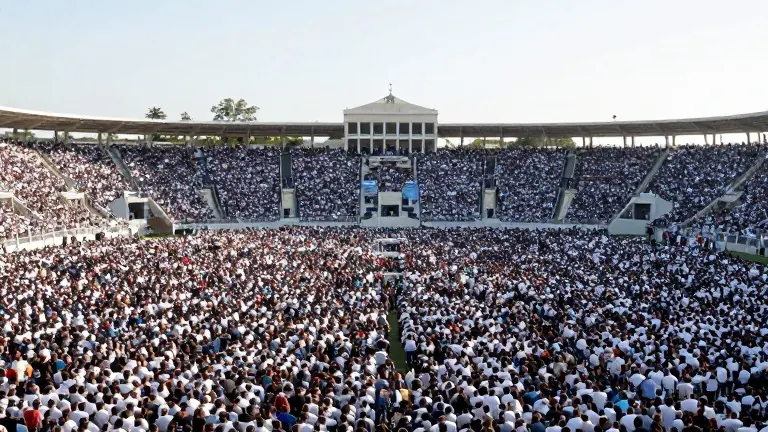
Pope Leo XIV told an estimated 650,000 people in Córdoba, Argentina, on Tuesday that they are called to follow the example of the country's saints. This gathering marked the second stop of his visit, following a service in Buenos Aires the previous day that drew roughly 2.5 million people.
The central location of Córdoba made it a strategic choice for the visit, which ended a nearly 40 year absence of a papal trip to the city. Leo described the area as a land of saints, noting the presence of figures canonized by his predecessor, Pope Francis. He specifically named St. José Gabriel del Rosario Brochero, known as the Gaucho priest, and Mama Antula, Argentina's first female saint.
During the homily, Leo emphasized that while these holy figures have completed their earthly missions, the current generation must carry forward their example. He told the crowd, We are all called to holiness. These saints and blesseds have already fulfilled their mission on Earth. Today, it is our turn to follow the radiant example of holiness they have left with us.
The liturgy took place at the grounds of the Argentine Aircraft Factory, a site with a heavy historical weight. The air force plant built the attack planes used in late 1975 against leftist guerrillas, an event that preceded the 1976 to 1983 military dictatorship. Human rights groups estimate that approximately 30,000 people were killed or disappeared during that era of state terror.
After the mass, Leo surprised the crowd by appearing on the balcony of the archbishop's residence. It is the same balcony where St. John Paul II greeted the city in 1987. Thousands of people in the street below chanted his name. The pope told them that unity gives them the power to accomplish anything.
Travelers made long journeys to attend. Erika Viñales, 39, and Elena Llanquenao, 54, are religious education teachers from Santa Cruz province in Patagonia. They drove more than 1,200 miles to be present. Viñales noted that the trip was quite a journey.
Leo also met privately with 20 individuals selected by the local archbishop, including families affected by the dictatorship. Alba Camargo, 64, attended with this group. Her father, stepmother, aunt, and uncle all disappeared during the military rule. She told the pope she represented relatives still searching for remains at La Perla, a former clandestine detention center outside Córdoba.
Camargo handed Leo a folder containing photos of recent excavations and the names of identified victims. She recalled that he listened closely, took her by the hand, and blessed the Franciscan crosses she had brought. She described the moment as unbelievably powerful, feeling him as a human being listening from 15 centimeters away.
The meeting occurred two weeks after forensic anthropologists identified the remains of nine missing people from La Perla. Camargo said she hoped the visit would bring change, especially as President Javier Milei's government has reduced funding for memorial sites. The administration has also promoted a revisionist view of the military's actions, framing them as excesses in a war against guerrillas rather than systematic terror.
Camargo expressed frustration with this narrative, stating it is exhausting to have people constantly telling you that what you've lived through your entire life isn't true. While Leo's speech in Córdoba focused on faith, his earlier comments in Buenos Aires about protecting the vulnerable have influenced local politics. Four senators from Milei's party began preparing to advance a stalled bill banning online gambling ads, a measure the church has supported to protect children.
Foreign Minister Pablo Quirno acknowledged that the pope's remarks exposed national shortcomings. He told Argentine TV channel TN that the message challenges the political class and society to address what the country lacks. The local host, Cardinal Ángel Rossi, has been a vocal critic of Milei, calling recent cuts to aid for the disabled and retirees state and institutional sadism. Córdoba governor Martín Llaryora wrote on social media that the visit offered a divided country a challenge to find common ground.