Three tankers hit by mines in Strait of Hormuz as US expands sanctions
Iranian forces reported that three oil tankers caught fire after striking naval mines in the Strait of Hormuz, an incident occurring as the United States broadens its financial pressure on Tehran.
By News Media House Staff ·
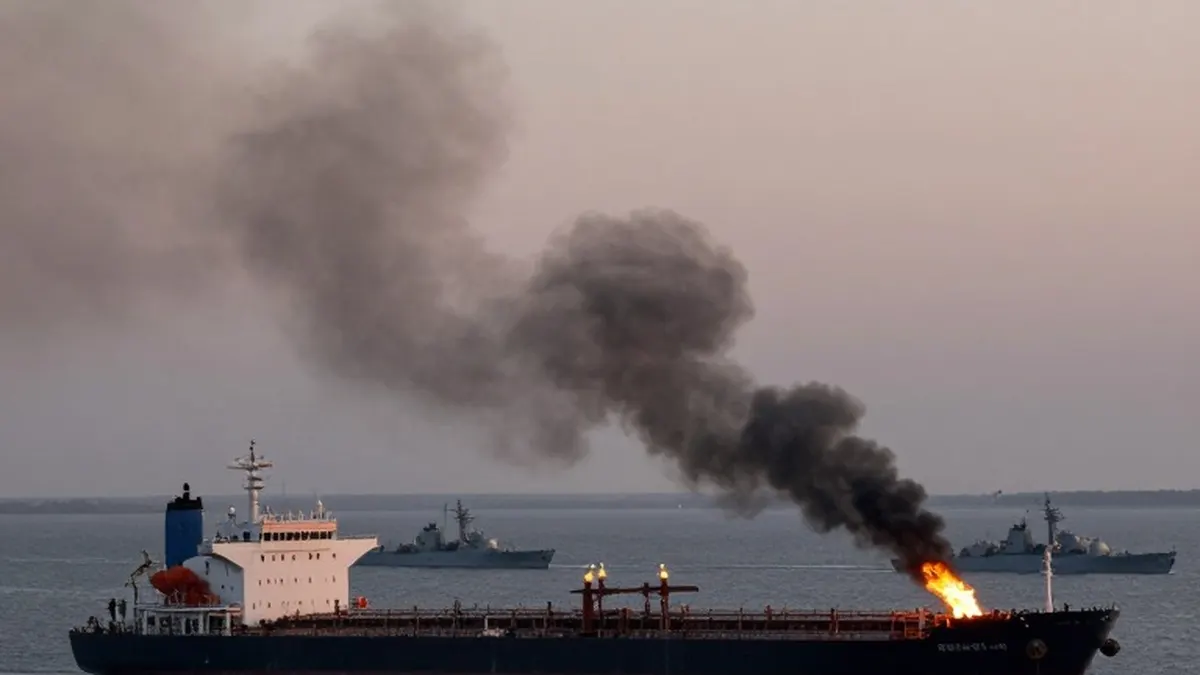
Iranian military officials announced that three oil tankers sustained significant damage after colliding with naval mines in the Strait of Hormuz. The incident represents the latest in a series of disruptions within the vital waterway. This development coincides with an escalation in U.S. sanctions designed to sever Tehran's financial connections to the global economy.
The Islamic Revolutionary Guard Corps detailed the event in a statement released by the state news agency IRNA. The report described three vessels as 'offending' tankers that experienced severe explosions and fires. One ship was located near the southern coast, while the other two were situated in the eastern section of the strait. All three vessels were under the protection of extensive U.S. military air cover and naval escorts, yet the protective measures did not prevent the detonations.
The IRGC statement emphasized that military protection does not substitute for adherence to maritime rules and directives from the IRGC Navy Traffic Control Center. Iranian forces have consistently warned commercial operators that only the northern shipping lane is approved for safe transit. Ships using alternative routes near Oman have faced threats or attacks in previous incidents.
The U.S. strengthened its naval presence in the Gulf last week by adding the USS Theodore Roosevelt to the region. This carrier joined two others in a fleet tasked with enforcing a blockade on Iranian ports. The expansion of the naval force underscores the intensity of the standoff in the area.
The maritime incidents followed an announcement from the U.S. Treasury Department on Monday. The department imposed new sanctions on more than two dozen Iranian exchange houses, front companies, and key personnel. Officials characterized the move as a comprehensive effort to dismantle Iran's global shadow banking networks.
Tehran's economy has faced increasing strain as Washington has expanded sanctions under a campaign called Operation Economic Outcast since August. The strategy aims to weaken the financial structures that support the country's oil revenue. Treasury Secretary Scott Bessent described the Iranian economy as underwater in a Monday statement. He noted that the shadow banking system served as the last financial lifeline for what he termed a bankrupt regime.
The conflict has also spilled into cyberspace. According to a report from The Wall Street Journal, Washington is investigating Iran as a primary suspect in dozens of cyberattacks targeting energy tankers. Up to fifty ships carrying oil, liquefied petroleum gas, and chemicals were believed to be targeted. Some vessels received warnings or bomb threats, according to U.S. officials cited in the report.
U.S. authorities are also examining Russia as a potential contributor to the cyber campaign. The report suggested that the attacks and occasional ransom messages are part of an Iranian strategy to instill fear among shipowners and further disrupt energy flows. The foreign ministries of both Iran and Russia did not respond to requests for comment from CNBC.
The broader conflict, which began with U.S. and Israeli strikes in late February, has seen Iran close the Strait of Hormuz while the U.S. blocks Iranian ports. This squeeze on energy shipments affects one of the world's most critical shipping routes. Despite the continued attacks, oil futures dipped slightly on Tuesday as investors focused on rising regional supplies.
International benchmark Brent crude fell to $89.20 per barrel, while U.S. West Texas Intermediate crude dropped to $80.10 per barrel. These figures are down from the October high of nearly $105 per barrel. Gregory Brew, a senior analyst at Eurasia Group, noted that supply constraints have loosened as regional crude supply recovers and Russian exports rebound. However, he warned that intensifying attacks in the strait could reverse this trend, estimating Brent will likely remain in the lower half of the $80 to $100 range.
Originally published by News Media House
More News · National news · Report a business · Got a Story?