Iowa farm turns 2,000-hog barns into mushroom facility after $400,000 debt
The Faaborg family in central Iowa replaced industrial pig farming with specialty fungi, using a converted barn as a data hub for other producers seeking to exit the industry.
By Ibrahim Howard ·
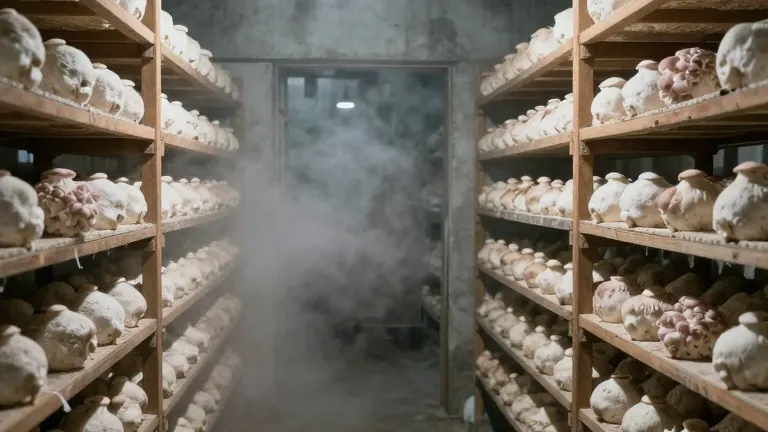
Fog rolls over shelves of sprouting fungi inside a dimly lit building in central Iowa.
Tyler Faaborg stands behind a plastic curtain, pointing to bulbous lion’s mane mushrooms that are currently pinkish. He explains that they will turn almost entirely white in another week before harvest.
The Faaborg family, which includes Tyler, his brother Tanner, and their parents Rand and Tammy, now runs 1100 Farm. The name references the 1,100 hogs that once occupied each of their two buildings. The operation sells tinctures, coffee blends, and flavored salt rather than pork.
The shift from pigs to mushrooms was facilitated by The Transfarmation Project, a division of Mercy for Animals. The organization provides open-source blueprints for repurposing industrial barns and offers technical and financial support to farmers leaving concentrated animal feeding operations.
Katherine Jernigan, the project director, stated that the program helps industrial animal farmers move into sustainable practices such as growing mushrooms, vegetables, or agroforestry. She noted that the organization’s unique value lies in repurposing existing infrastructure.
The transition follows a decades-long history on the 25-acre property. Rand Faaborg bought the land in the 1980s and initially raised hogs for pocket money while working as a welder. He later entered contract feeding, where a company supplied animals and feed while the family provided labor and infrastructure.
Rand Faaborg spent 12 years paying off a $400,000 debt for two new hog barns equipped with automatic feeders and manure systems. The family raised approximately 8,000 hogs annually, producing one million gallons of liquid manure stored in open pits. Rand Faaborg recalled working 16 to 24 hour days during this period.
Over 35 years, Rand Faaborg’s welding income increased tenfold, while his profit from raising hogs dropped by two-thirds. The family decided to exit the hog business several years ago to prevent the buildings from falling into disrepair. Tanner Faaborg proposed retrofitting the structures for a specialty crop.
The family began working with Transfarmation in 2021 and sold the last herd of hogs in 2022. A $15,000 grant in 2023 funded a year-long pilot project. Site preparation, supplies, and branding cost roughly $35,000.
The family completed the conversion of half of one 200-foot barn this summer. This retrofitted space serves as Transfarmation’s second demonstration hub in the United States, following a similar site in North Carolina. The farm is compensated $216,000 over four years for tracking and sharing data on costs, labor hours, and product margins.
Jernigan said the hub allows other farmers to inspect the transition and review production data. The transparency aims to show that profitability is possible when switching from concentrated animal feeding operations to specialty crops.
The property also underwent environmental changes. A former manure pit, which previously caused anxiety over capacity and hauling logistics, was converted into a freshwater pond with support from a USDA Natural Resources Conservation Service grant. Rand Faaborg described the pond as his favorite part of the new operation, noting that his grandchildren catch frogs there.
More Business · Consumer Alerts · Report a business · Got a Story?